Top Signs You Need Garage Door Service – Don’t Ignore These
A garage door that takes two seconds longer to open than it did six months ago isn’t just slow. It’s telling you the spring tension is dropping and the opener is compensating by working harder than it should. That pattern has a predictable endpoint, and it’s usually a snapped spring at the least convenient moment. The signs that matter most in Highland Park are rarely the dramatic ones. They’re the quiet mechanical changes that show up months before something fails.
Here’s what to actually watch for, and what each symptom is telling you. If you’d rather not climb a ladder to check, call (844) 742-5213.
Key Takeaways
- Slow opening is a spring warning, not a door problem
- The halfway test takes 10 seconds and reveals spring wear early
- Different sounds point to different failing parts; straining and grinding are not the same
- An uneven bottom gap usually means a cable tension issue
- Fall is the highest-risk season for Highland Park doors because of seasonal temperature swings
What does a garage door do before it fails?
Before a garage door fails, it almost always changes its behavior first. It slows down, gets louder, hesitates, or lifts unevenly. Those are mechanical stress signals, and they usually appear weeks to months before a spring snaps or a cable lets go. Catching them early is the difference between a straightforward repair and a door that’s jammed shut with a car trapped inside.
The reason so many homeowners miss the warning is that garage doors age gradually. You don’t notice a door getting 10% slower each month, because you see it every day and the change is invisible against that baseline. That’s why a deliberate check matters more than passive observation. In our experience, the most common call we get isn’t “it broke suddenly.” It’s “it’s been acting strange for a while and I finally called.”
Here’s the pattern worth knowing. When spring tension weakens, the door feels heavier to the opener. The opener compensates by pulling harder. For a while, the door still opens and closes, so nothing looks wrong. But the opener motor and gear assembly are now carrying load they weren’t designed to carry, and the spring is one cold morning away from failing outright. A door that has been quietly struggling for months will still snap without warning, which is exactly why the subtle signs matter more than the obvious ones.
How do you do the halfway test to check spring wear?
The halfway test checks whether your springs still balance the door. You manually lift the door to about halfway, let go, and watch. A healthy door stays where you put it or drifts only slightly. A door that sinks back down or drops fast has weak springs. It takes about 10 seconds and it’s the single most useful mechanical check a homeowner can do.
Here’s the part most people find out the hard way: do this test with the door disconnected from the opener, using the release cord, and never place your hands near the springs, cables, or hinges while doing it. Lift from the bottom edge, keep the door in view, and stay clear of the opening. If the door feels heavy, binds, or drops rather than holding, stop and don’t force it.
A door that sinks on the halfway test in Highland Park is a door running on tired springs, and it’s usually within a season of snapping. A door that holds strong is balanced. If it holds but the opener still strains, the problem is somewhere else in the system, which is where sound comes in. That distinction alone saves a lot of guesswork. Spring repair is genuinely one of the more hazardous jobs in the trade, which is why we handle it as a dedicated service rather than folding it into a general repair call.
When to call a pro: if the door drops during the test, if it lifts unevenly, or if you hear any scraping while lifting it by hand, stop testing and get it looked at. Springs are under high tension and a trained technician should be the one to touch them.
What do grinding, scraping, and popping sounds actually mean?
Grinding, scraping, and popping sounds each point to a different failing component, and homeowners routinely mix them up. Grinding usually means a track, roller, or hinge problem. Scraping often means the door is dragging or misaligned. Popping or snapping can point to a spring, cable, or hinge failure. Matching the sound to the part saves time and money.
- Grinding (a rough, continuous metal-on-metal sound): usually worn rollers or a dry, misaligned track. The door is riding against steel instead of rolling smoothly. This is a track or roller issue, not a spring issue.
- Scraping (a dragging or rubbing sound): the door panel is contacting the frame, the track is out of line, or a bent section is dragging. Check whether the door shifts to one side as it moves.
- Popping or snapping (a sharp crack single sound): often a hinge, roller, or cable under load, and occasionally the start of a spring problem. A loud snap that leaves the door unable to lift is a spring failure, and that’s an immediate stop-use situation.
- A straining opener (a labored motor whine, not metal noise): the motor is working harder than it should. This is the opener compensating, usually for a weakening spring. This is the confusion that matters most: opening/straining sound equals opener load; grinding equals track or roller.
Brand and system familiarity helps here more than most homeowners realize. We work on Genie and Clopay systems regularly, along with LiftMaster, Chamberlain, Amarr, Wayne Dalton, Craftsman, and Raynor, so diagnosing whether a noise is coming from the door or the opener on a specific system is quicker work than starting cold. Our technicians have up to 12 years of experience.
Why does an uneven gap at the bottom of a closed door matter?
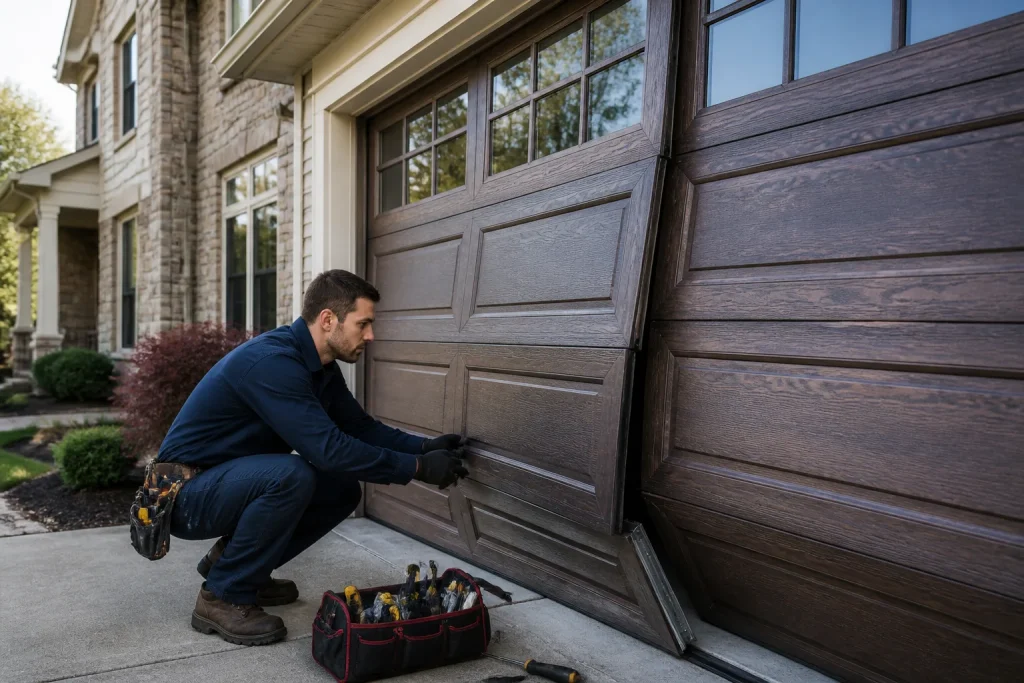
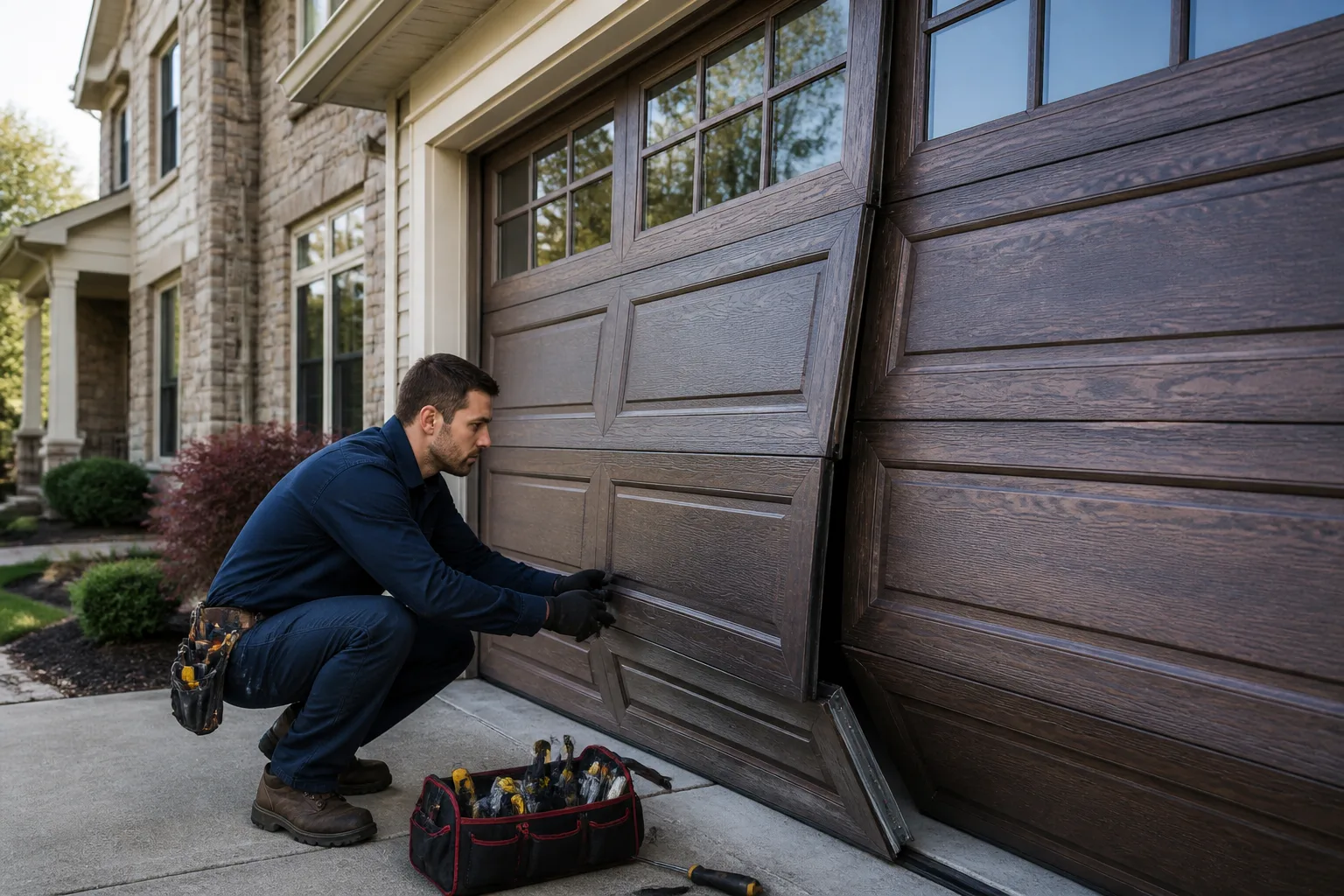
An uneven gap at the bottom of a closed door is usually a cable tension warning, not a cosmetic issue. A sagging corner or a visible wedge of light means one side of the door is being pulled differently than the other, which points to a cable that is loose, fraying, or out of balance. Left alone, that difference worsens until the door jams or a cable fails outright.
Check it in good light with the door fully closed from the outside. Walk the length of the bottom edge. If the gap is even across the whole width, you’re fine. If one corner sits noticeably lower or higher, or the door looks slightly twisted, that’s the cable signaling. A door that closes crooked also strains the track and rollers every time it moves, so a cable problem often turns into a track problem over time.
An uneven gap also lets in drafts, water, and pests, which is a comfort and weather issue in Highland Park’s seasonal shifts, but the mechanical signal is the important one. Cable work carries the same hazard as spring work and should never be a homeowner task. If you see a crooked bottom edge, get it diagnosed before it becomes a stuck door.
Why is fall the highest-risk season for Highland Park garage doors?
Fall is when Highland Park garage doors fail most often because seasonal temperature swings stress the metal hardware in ways warm-weather months don’t. The cause is ordinary thermal movement: springs contract in cold, cables and track respond to temperature shifts, and a system that was tuned for summer relief is now carrying a different load. Tired components choose that season to give out.
That makes fall the best time for a preventive check, before the first cold morning finds the weak part. A simple fall routine helps:
- Do the halfway test once the weather cools, and again in early spring
- Listen for new grinding or straining sounds that weren’t there in summer
- Check the bottom gap after the door settles through a temperature swing
- Look for gaps in the weather seal that let cold air under the door
These temperature swings are exactly why we recommend a check in fall rather than waiting for a failure. A door that ran quietly all summer and suddenly complains on a cold morning isn’t being difficult. It’s telling you a spring or cable is near its limit.
When should you call a garage door pro instead of waiting?
Call a garage door pro when the door drops during the halfway test, when a spring snaps, when a cable looks frayed or the door closes crooked, or when the opener strains or stalls. Those are signs the system is at or near failure. Waiting rarely costs nothing. It usually means a bigger repair later, or a door that won’t open when you need it to.
For Highland Park homeowners, the practical line is this: anything that involves springs, cables, or the opener’s mechanical load is a pro job. Springs store enormous energy, and the spring, cable, and bracket hardware that runs along the door is where serious injuries happen when untrained hands get near it. A trained technician and the right parts are the safe way to handle it.
Related services in Highland Park
If a sign points to a specific part, we cover the full system from the door to the opener to the springs. Our garage door repair and garage door opener repair handle most symptoms above, and when a door is beyond repair we handle garage door installation as well. Every price is quoted and agreed before any work starts, so there are no surprises on the invoice. Learn more about Highland Park Garage Door Repair Co.
The Bottom Line
The signs that matter most are the quiet ones: a door that’s slower than it used to be, a halfway test that doesn’t hold, a new grinding note in the track, or a crooked gap at the bottom. Read together, they tell you a system is under stress and give you time to act before a failure. Fall is the season to look closest, because Highland Park temperature swings push tired hardware over the edge.
If you’re in Highland Park and need help, Highland Park Garage Door Repair Co offers free estimates – call (844) 742-5213. We’ll diagnose your specific system, from the opener down to the springs, and quote the price before any work begins.
Frequently Asked Questions
The earliest signs are a door that opens more slowly than it did months ago, a door that sinks during the halfway test, new grinding or scraping sounds, and an uneven gap at the bottom when closed. These point to spring, cable, track, or opener stress. Catch them early and the repair is usually smaller. Call (844) 742-5213 for a free estimate.
A failing spring shows up as a door that won’t hold on the halfway test, a door that feels very heavy to lift by hand, or an opener that strains to lift it. A snapped spring usually stops the door entirely. Never try to adjust or replace a spring yourself. Call (844) 742-5213 and a technician can confirm it.
Occasional grinding from a worn roller or dry track is usually safe short-term, but continued use accelerates wear on the track and the door. A sharp popping or a door that stops mid-travel is not safe to keep cycling. Stop using it and call (844) 742-5213 before it jams.
No. The price is quoted and agreed before any work starts, so the number you approve is the price. We diagnose the issue and give you a written estimate first. Call (844) 742-5213 – estimates are free.
Written by the team at Highland Park Garage Door Repair Co.
Need Garage Door Help?
Call Highland Park Garage Door Repair Co - the local pro we connect you with is licensed and insured, here with fast after-hours help in Highland Park.
(844) 742-5213