Garage Door Repair: Repair or Replace? How Highland Park Homeowners Decide
A recommendation to replace a garage door should survive a little arithmetic. Too often it doesn’t. A technician who pushes a full replacement on a door with one bent panel and a tired spring system may be right, or may be steering a small cable repair toward a full install. Without a framework, Highland Park homeowners have no way to tell the difference. This piece gives you that framework: four variables, run in order, that turn a gut call into a decision you can defend.
Key Takeaways
- Repair wins when the cost stays below roughly half of what a new door costs installed.
- Door age and daily cycles tell you how much life the springs and hardware have left.
- Panel matching is the silent dealbreaker: if the panel is discontinued, cosmetic repair competes with replacement.
- Opener age belongs in the math. A 15-year-old opener on a new door is a hidden cost.
- Three or more repairs in two years is systemic wear. That’s the replacement signal.
How does the 50% rule apply to a garage door in Highland Park?
When cumulative repair costs approach half the price of a new door installed, replacement math starts to favor you. That’s the 50% rule, and it works because a new door resets every wear item at once. In Highland Park, most homeowners are working with older housing stock where doors are already past their first big repair cycle, so the cumulative number matters more than any single invoice.
Run it like this. Take what you’ve spent on the door over the past couple of years, add the quote in front of you, and compare the total to an installed replacement price. If you’re at 40% and climbing, you’re in the decision zone. If you’re past 50%, you’re usually paying for a door twice.
A typical repair job in Highland Park falls into rough ranges: a cable or roller repair is a modest invoice, a single spring replacement costs more, and a matched pair of springs roughly doubles a single-spring price. We’ve seen doors where two spring replacements plus a cable job crossed the halfway point inside a few years. At that stage, the next failure isn’t a question of if.
One caution: the 50% rule is a starting point, not a verdict. A door in otherwise solid shape with one failed component is still a repair. The math only tips toward replacement when the repairs keep landing on different parts of the same aging system.
Why does panel availability change the repair-or-replace math?
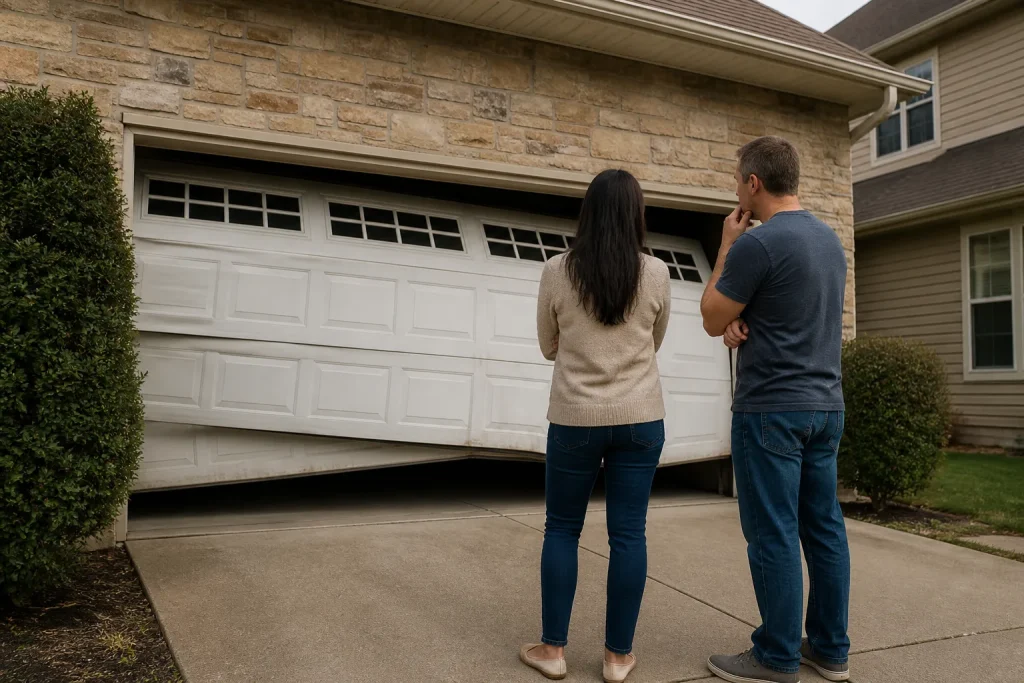
If the damaged section can’t be matched, a “simple” cosmetic repair suddenly competes with full replacement. Sectional doors are assembled from panels, and those panels get discontinued. Manufacturers retire profiles and colors on their own timelines, and a door installed fifteen or twenty years ago is frequently out of production. When the match is gone, you’re weighing a mismatched patch or a full face of new panels.
Panel availability is worth checking before anyone quotes a repair. A few practical notes:
- Colored and textured panels go out of production faster than plain white.
- Panel profiles are brand-specific, which is why we work on the major lines: Clopay, Amarr, Wayne Dalton, and Raynor among them. Familiarity with a brand’s panel history saves guesswork.
- A discontinued panel isn’t always fatal. Sometimes an alternate profile works, sometimes a shop can fabricate one. Ask before assuming.
- If the panel is gone and the door is old enough to be out of production anyway, cosmetic replacement usually loses to full replacement on value.
This is where a general handyman stalls. A specialist who works across brands knows which panels are still sourced and which aren’t, and can tell you in one visit whether matching is realistic. Otherwise you order, wait, discover the mismatch, and start over.
How do age and cycle life estimate what’s left in your door?
Every part of a garage door has an expected service life measured in cycles, and a cycle is one open-and-close. Springs, cables, rollers, and hinges all wear on that clock. Estimating your door’s remaining life means multiplying daily cycles by its age, then comparing that against what the hardware is rated to handle.
Most residential doors run a handful of cycles a day. A household where someone leaves for work and returns, plus a school pickup or two, sits at four to six cycles daily. Over a couple of decades, that’s tens of thousands of cycles, which is exactly where torsion and extension springs start to fail in Highland Park’s older homes.
What that means for repair investment:
- Springs are the wear item that fails first. A single spring replacement gets you another cycle life; a matched pair replaced together is the standard approach because the second spring is typically on the same clock.
- Cables wear at the drums and pulleys. A snapped cable usually means the door comes down hard, so it’s not a repair to defer.
- Rollers and hinges are cheap and worth replacing when they’re noisy or worn, even mid-life.
- Panels and tracks only get replaced when damaged. Most doors never need them.
If the springs were replaced recently but the cables and rollers are original, you’re fine to repair. If the hardware is original and you’re replacing springs for the second time, the replacement math starts to favor a new door.
Why does opener age belong in the repair-or-replace decision?
A 15-year-old opener attached to a new door is a hidden cost most homeowners don’t factor in. The door and the opener are separate systems, but you can’t cleanly replace one and ignore the other. A new door is heavier and often stiffer, and an old opener may struggle from day one.
Older units also carry safety gear that predates current standards, and the parts are often hard to source. When we quote a replacement, we factor opener age in because a homeowner who replaces the door and keeps a tired opener ends up back on the phone within a season. That’s a call we’d rather avoid.
If you’re weighing the opener separately, the brands in Highland Park homes are usually LiftMaster, Chamberlain, Genie, or Craftsman, and we work on all of them. We diagnose the actual fault before recommending a swap. An opener that’s noisy but working may just need adjustment; one that’s stalling or reversing on its own is a different conversation.
If you’d rather have a professional sort the opener out, our garage door opener repair page covers what a visit looks like.
When is replacement almost always the right answer?
When a door has had three or more repairs in 24 months, replacement is usually the answer regardless of the cost of the latest fix. That pattern signals systemic wear: the failure moves from part to part because the whole system is past its cycle life. Each repair fixes one item while the next one is already on the way out.
We’ve seen doors where homeowners spent the cost of a replacement on three separate repairs over two years before pulling the trigger on a new door. The repairs weren’t wrong; they just weren’t the whole story. A specialist watching the total spend spots the pattern sooner.
Other signals that point straight to replacement:
- Repeated repairs across different components.
- Out-of-production panels with visible damage.
- A torsion or extension spring system replaced twice on an original door.
- An opener at the end of its useful life being paired with a failing door.
- Structural damage to the panels or tracks that can’t be repaired cleanly.
Replacement is a measured job, not an emergency one. The door is sized, ordered, and scheduled, and you get a written price before anything is ordered. If the situation is urgent, our garage door repair page explains the shorter path, and garage door installation covers the full replacement process in Highland Park.
When should you call a pro in Highland Park?
Call a professional the moment a spring or cable is involved, and sooner if the door feels heavy or drops on its own. High-tension springs are genuinely dangerous; they store enough force to cause real injury, and a tuning adjustment on a torsion system is not a homeowner task. Don’t attempt it. A trained technician has the tools and the knowledge to release tension safely.
For the smaller stuff, you can check and diagnose but not repair: a door that reverses on its own, squeaks, or stops short is a symptom worth describing to a pro. We diagnose the actual fault before recommending work, and we quote and agree on the price before the job starts. That’s the rule, whichever route you take. If the quote changes once the door is open, it’s because we’ve found something we can’t see from the driveway, and we’ll tell you before we proceed.
Related services in Highland Park: our garage door repair and garage door opener repair pages cover everyday fixes, while garage door installation covers full replacement. If you want the whole range, Highland Park Garage Door Repair Co is the place to start.
The Bottom Line
Run the math in order. Add up what you’ve spent and what you’re about to spend. Compare that to installed replacement. Check whether the panel can still be matched. Count the cycles on the springs and the age of the opener. If you’re past half the replacement price, or you’ve had three repairs in two years, replacement usually wins. If it’s one component on a door with life left, repair does.
Our technicians have up to 12 years of experience across the major residential brands, and we work from the door to the opener to the springs. If you’re in Highland Park and need help, Highland Park Garage Door Repair Co offers free estimates. Call (844) 742-5213 and we’ll give you a written price before any work begins.
Frequently Asked Questions
You repair when the cost stays under roughly half of installed replacement and one component has failed. You replace when repairs have crossed that line or when you’ve had three or more fixes in two years.
Sometimes. It depends entirely on whether the panel profile and color are still available. If the manufacturer has discontinued your panel, matching becomes difficult and full replacement is often the better value.
Not automatically, but it matters. A new door paired with a 15-year-old opener usually means a second repair shortly after. Factor opener age into the total before you decide.
Springs are rated in cycles, not years, and a typical household runs several cycles a day. At that pace, springs often reach the end of their life well before the door itself does. If you’re unsure how much life is left, call (844) 742-5213 for a free estimate.
Written by the team at Highland Park Garage Door Repair Co.
Need Garage Door Help?
Call Highland Park Garage Door Repair Co - the local pro we connect you with is licensed and insured, here with fast after-hours help in Highland Park.
(844) 742-5213